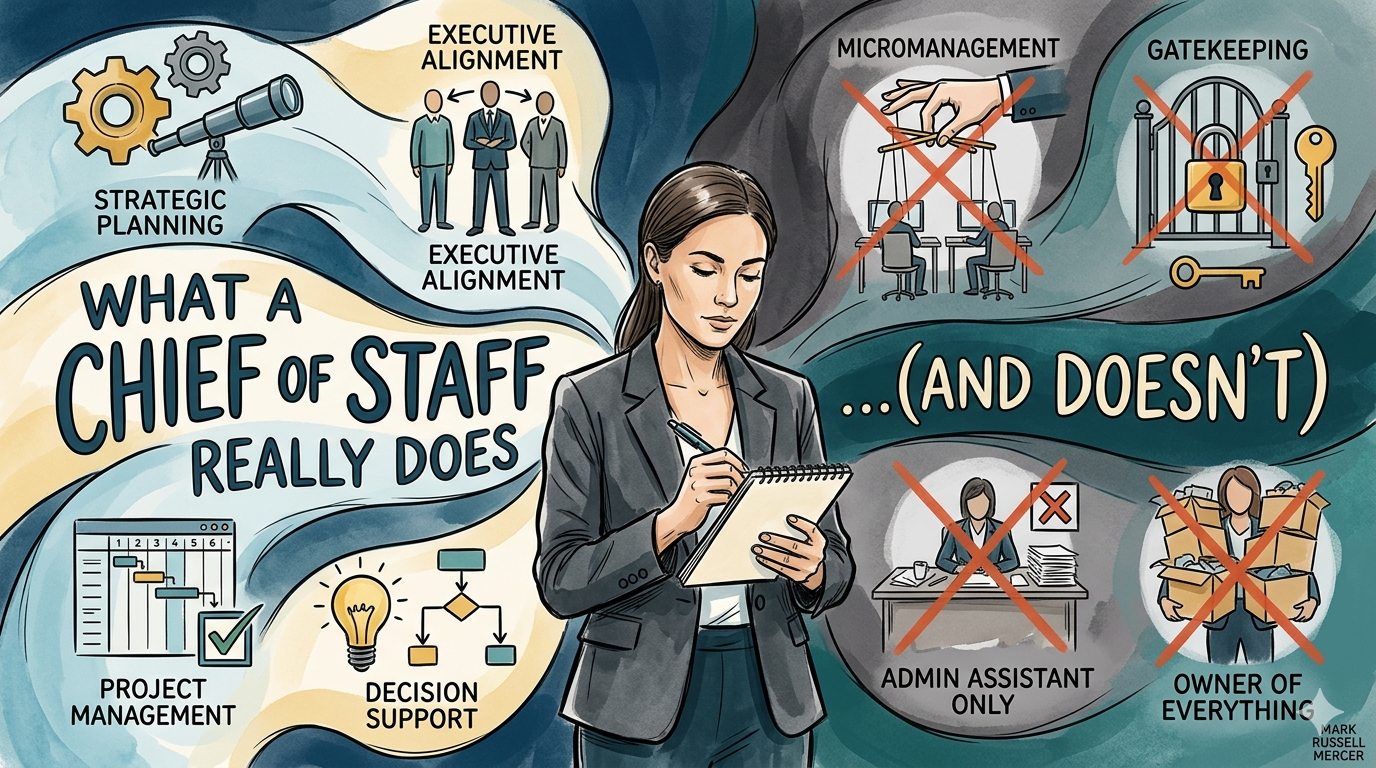
What a Chief of Staff Actually Does (And Doesn't)
There's a question I get more than any other: "So... what do you actually do?"
By Mark Mercer
There's a question I get more than any other: "So... what do you actually do?"
It usually comes with a slight tilt of the head. Sometimes a polite smile. Occasionally a follow-up like, "Is that like an executive assistant?" or "So you're basically the CEO's right hand?"
Not exactly. And definitely not exactly.
I'm the Chief of Staff at Firecrawl, a fast-growing AI startup in San Francisco. I've held the role for over a year now, and I still think most people — including people in tech — don't really understand what a Chief of Staff does. So let me try to clear it up.
What a Chief of Staff actually does
The simplest way I can put it: I make sure the company runs while the founders build the product.
That sounds broad because it is. On any given week, I might be negotiating a vendor contract, onboarding a new hire, managing our global tax registrations, planning a team offsite in Miami, reviewing our insurance coverage, writing an internal performance recap, or standing in a hardware store picking out shelving for the office I designed and built from scratch.
The role lives in the white space. It's every critical thing that doesn't fit neatly into an engineering sprint or a sales pipeline but absolutely has to get done for the company to function. Some of it is strategic. A lot of it is operational. All of it matters.
Here's a non-exhaustive list of what I own or have built at Firecrawl:
People & HR — I built our onboarding program, employee handbook, bonus structure, quarterly review framework, and performance evaluation system. I run People Ops. I'm the confidential layer between employees and founders.
Hiring — I centralized recruiting across multiple platforms, source candidates, manage every offer letter, and handle all hiring paperwork. I personally recruited our Head of Legal & Finance, negotiating a structure that cut outside counsel costs by $25,000 a month.
Legal & Compliance — I initiated 76 global tax registrations, trademarked our name and logo, overhauled our insurance across seven policy lines, cleaned up equity documentation, and manage all contracts and NDAs.
Finance — I manage billing through Brex, consolidated our finance tooling, led a company-wide vendor audit, and handle payroll workflows across PEO, EOR, and contractor models.
Office & Facilities — I designed and opened our SF headquarters end-to-end and run it day-to-day.
Events & Culture — I conceptualized and emceed a YC hackathon that drew 495 applicants, raised $60K in sponsorships, and distributed $5.2M in prizes. I created "Firecrawl After Dark," a monthly late-night developer event. I plan and execute team offsites.
Communications — I write monthly company performance recaps and coordinate cross-functional communication to keep 26 people aligned.
If you're keeping count, that's seven distinct functions. At a larger company, that's seven different people — or seven different departments.
What a Chief of Staff doesn't do
Let me be equally clear about what the role is not.
It's not an executive assistant role. I don't manage anyone's calendar or book travel for the CEO. I'm not handling personal errands. The EA and CoS roles share a surface-level similarity — they both exist to make leadership more effective — but the CoS operates at a strategic and operational level, not an administrative one.
It's not a project manager role. I don't track Jira tickets or run standups. I'm not embedded in a product team shipping features. When I manage projects, they're company-level operational initiatives, not product roadmap items.
It's not a "figure it out" dumping ground. At least, it shouldn't be. The best CoS relationships work because there's a clear understanding of what the CoS is uniquely positioned to handle versus what should go to a functional lead. I protect my time the same way I protect the founders' time — by being intentional about what I take on.
It's not a temporary role. Some companies treat the CoS as a rotational program or a stepping stone. For me, it's the role itself. Building operational infrastructure, scaling people systems, creating culture — this is the work I want to do, not a waypoint on the path to something else.
The skill set nobody tells you about
Most CoS job descriptions list things like "strategic thinking" and "cross-functional collaboration." Those are real, but they're also generic enough to describe half the roles in tech.
Here's what I think actually makes someone effective in this seat:
Comfort with ambiguity. Half of my job on any given day is something I haven't done before. You have to be genuinely comfortable figuring things out in real time — not theoretically comfortable, actually comfortable.
Taste. This one sounds strange, but I mean it. A good CoS has opinions about how things should feel — the onboarding experience, the office layout, the way a company update is worded, the vibe of a team offsite. Operations isn't just mechanics. It's experience design.
Speed without sloppiness. Startups move fast. The CoS has to move faster. But moving fast and breaking things is not the same as moving fast and building things that last. I build systems that I won't have to rebuild in three months.
Emotional intelligence. You're sitting between founders and the team. You hear things from both sides that neither side says to each other. Handling that with discretion, empathy, and honesty is probably the most undervalued part of the job.
Range. This is the big one. You need to be able to context-switch from a legal compliance question to a design decision to a difficult conversation with an employee to an event sponsorship negotiation — all in the same afternoon. Not everyone can do that. Not everyone wants to.
I can. And I do.
The punchline
A Chief of Staff is the person who builds the company around the product. The founders build the thing. I build the machine that lets the thing grow.
If your startup has reached a point where the founders are spending more time on operations than product, where things are falling through cracks, where nobody owns the stuff between the departments — you might need one of us.
And if you're someone who loves building from scratch, thrives in ambiguity, and has an unusual mix of skills that doesn't fit neatly into any single job description — you might already be one.
Mark Mercer is the Chief of Staff at Firecrawl. Before that, he built CX organizations, directed 2500+ performers, and ran retail teams. He lives in San Francisco with his partner Anthony and their Boston Terrier, Milo.