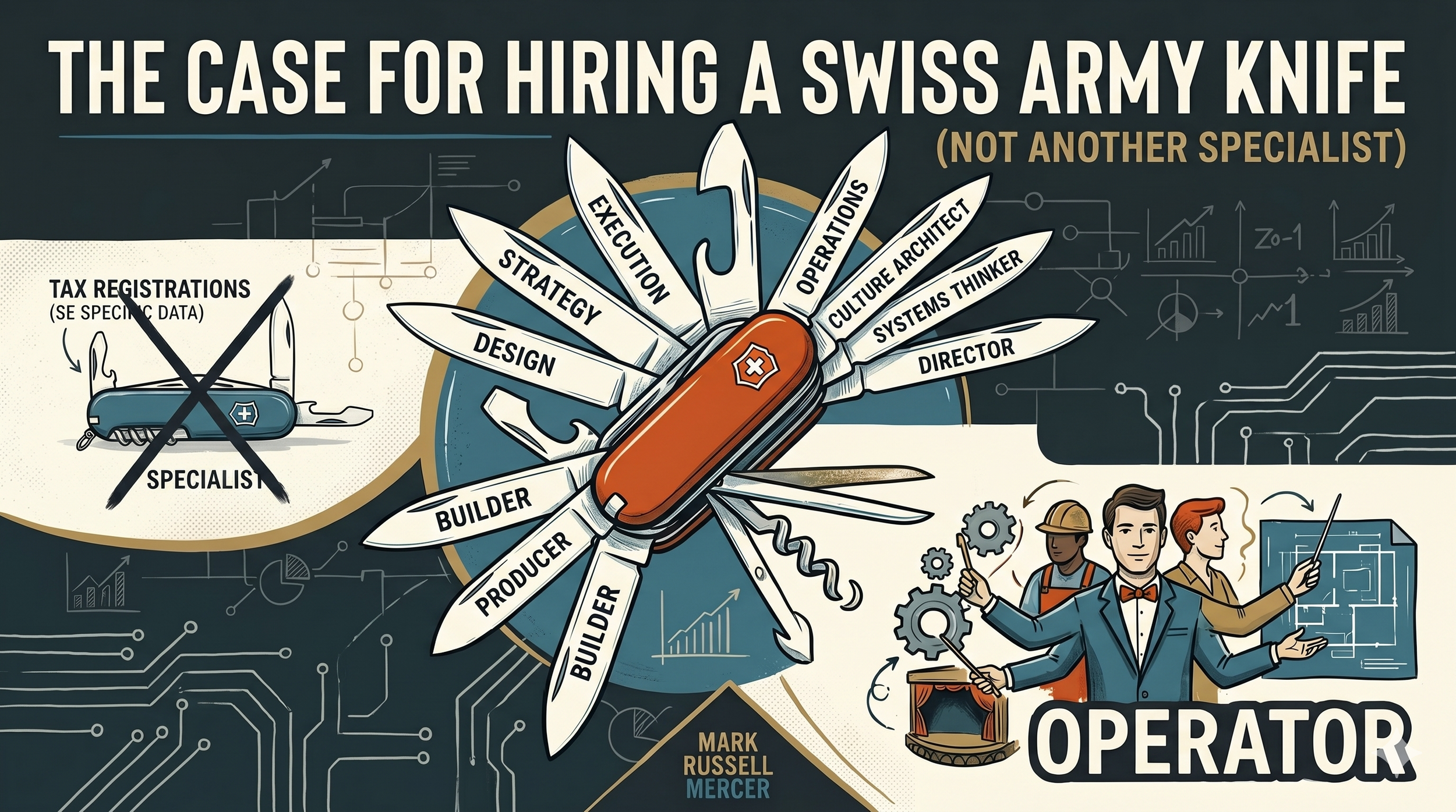
The Case for Hiring a Swiss Army Knife (Not Another Specialist)
Every hiring framework in tech tells you to hire specialists.
By Mark Mercer
Every hiring framework in tech tells you to hire specialists. Find the person who's world-class at one thing. Don't hire generalists — they're a mile wide and an inch deep. Specialists ship. Generalists dabble.
I think that advice is mostly right. And I think it's completely wrong for one critical role at every fast-growing company.
Let me make the case for the Swiss Army Knife.
The specialist trap at early-stage companies
Here's what I've watched happen at startups: a company reaches 15–30 people. The founders are drowning. They're spending half their time on operational tasks they shouldn't be touching — HR questions, vendor negotiations, compliance issues, office logistics, team coordination, hiring pipelines.
So they do what every hiring framework tells them to do. They hire a specialist.
They bring in a Head of People. Great — now HR is covered. But who's managing the office buildout? Who's coordinating the team offsite? Who's handling the insurance transition? Who's managing the vendor audit?
So they hire another specialist. And another. Now they've got a Head of People, an Office Manager, and they're talking to outside counsel for legal, a recruiting firm for hiring, and an events company for the offsite.
That's five line items on the budget to cover work that one person — the right person — could own entirely.
What a Swiss Army Knife actually is
I want to be precise about this because "generalist" has a bad reputation, and honestly, it's partly deserved. A generalist who's mediocre at everything is not what I'm describing.
A Swiss Army Knife is someone who is genuinely good at many things — not because they've dabbled, but because they've done real work across multiple domains. They've built teams. They've managed budgets. They've designed experiences. They've handled compliance. They've produced events. They've negotiated contracts.
The key difference: a generalist says "I can figure it out." A Swiss Army Knife says "I've done it before — here's what I built and here are the results."
My own path is a good example. Before I became Chief of Staff at an AI startup, I:
Ran retail stores, managing 50+ employees and hitting 115% of sales targets
Directed 2500+ performers across 50+ productions over 13 years
Founded a theater company and a national competition drawing 5,000+ spectators
Built a customer experience organization from 1 to 14 people across two continents
Cut support volume by 57% while maintaining 90%+ customer satisfaction
Led product redesigns that increased conversion by 40%
None of those are the same job. All of them built skills I use every single day. When I designed our office, I drew on the same spatial thinking I used staging productions. When I plan a hackathon, I draw on the same logistics muscle I built running competitions. When I build a hiring pipeline, I draw on the same recruitment instincts I developed filling 650-person programs.
Range isn't a weakness. It's compound interest.
When to hire the Knife
Not every company needs this person. If you're a 500-person company with established departments and clear functional ownership, you probably need specialists.
But if any of these sound familiar, you might need a Swiss Army Knife:
"Things are falling through the cracks." Not because anyone is bad at their job, but because there's an entire category of work that doesn't belong to anyone. It's the space between departments — too operational for the CEO, too strategic for an admin, too varied for any single specialist.
"The founders are spending 40% of their time on operations." If your technical co-founder is negotiating office leases and your CEO is managing vendor contracts, something has gone wrong. That's not what they should be doing. But the work still needs an owner.
"We hired a specialist but they can only do one thing." This happens all the time. The Head of People is great at HR but can't plan an offsite or manage an office buildout. The Office Manager is great at facilities but can't handle recruiting. You end up needing three people where one versatile operator could have handled it.
"We need someone who can build it from scratch." Specialists excel at optimizing existing systems. Swiss Army Knives excel at creating systems that don't exist yet. If you're at the stage where there's no playbook — no onboarding process, no employee handbook, no compliance framework, no event calendar, no office — you need a builder, not an optimizer.
The objection (and why it's wrong)
The most common pushback I hear: "But won't a generalist be mediocre at all of those things? Wouldn't I be better off with someone who's truly excellent at one of them?"
This makes sense in theory. In practice, at an early-stage company, it falls apart for two reasons.
First, you can't afford five specialists. You're a 20-person startup. You have the budget for one operational hire, maybe two. That hire needs to cover a lot of ground.
Second, the work itself is interconnected. The person managing your hiring pipeline should probably also be the person who designed the onboarding experience, who built the employee handbook, who planned the team offsite, and who understands the company culture well enough to know which candidates will actually thrive. When you split that across five different people, you lose the connective tissue. The Swiss Army Knife sees the whole picture because they own the whole picture.
What to look for
If you're convinced, here's what to screen for:
A non-linear career path. The best Swiss Army Knives didn't follow a predictable trajectory. They've worked across industries, functions, or contexts. That's not a red flag — it's the signal. Every career chapter built a different blade.
Proof of building from zero. Ask them what they've built when nothing existed. Anyone can optimize an existing system. The Knife builds the system.
High agency. This person doesn't wait for a job description to tell them what to do. They see what's broken, they figure out how to fix it, and they do it — ideally before anyone had to ask.
Taste and judgment. The Swiss Army Knife isn't just executing tasks. They're making hundreds of micro-decisions every week about how things should look, feel, and function. They need to have good instincts — about design, about communication, about people, about timing.
Comfort with context-switching. This is the hardest one to screen for but maybe the most important. Can this person go from a legal compliance conversation to a creative brainstorm to a difficult employee conversation to a budget review — all in the same afternoon — without dropping quality? Some people find that energizing. Most people find it exhausting. You want the former.
The return on range
I'll leave you with this.
In my first year at Firecrawl, I opened the office, built People Ops from scratch, initiated 76 tax registrations, recruited a Head of Legal & Finance (saving $25K/month), produced a hackathon that drew 495 applicants and $60K in sponsorships, created a monthly developer event series, planned three team offsites, trademarked the company, overhauled our insurance, built our first bonus structure, built our first performance review system, built our first employee handbook, launched automated swag fulfillment, and managed all vendor relationships, billing, and payroll.
That's one person. One salary. And every single one of those things would have been a different hire, a different contractor, or a different vendor — or it simply wouldn't have gotten done.
That's the return on range. That's the case for the Swiss Army Knife.
Hire the person who can do all of it. They're out there. I promise.
Mark Mercer is the Chief of Staff at Firecrawl. His career has spanned retail management, education, theater production, customer experience, and startup operations — which is exactly the point. Find him at markrussellmercer.com.
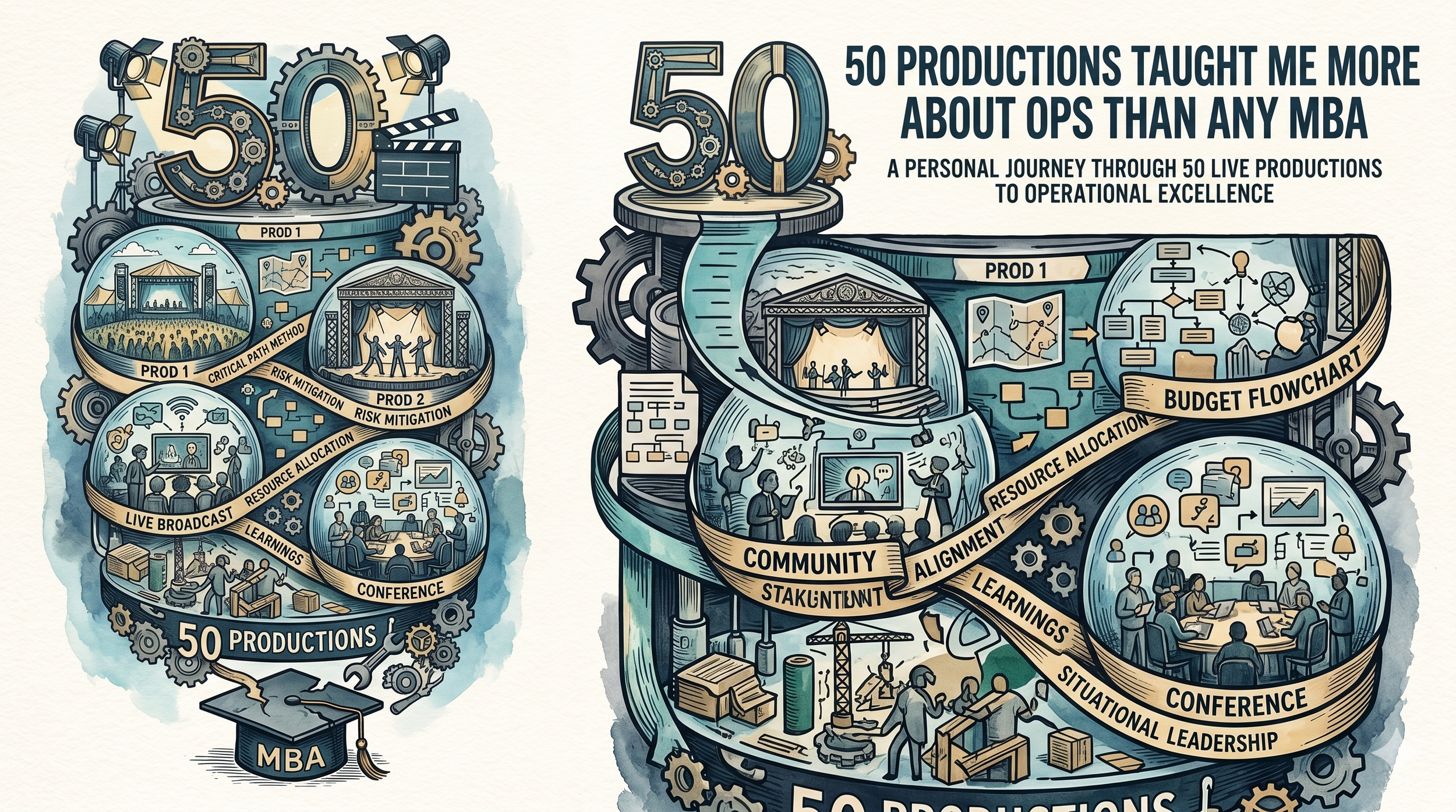
50 Productions Taught Me More About Ops Than Any MBA
I have an MBA in Finance.
By Mark Mercer
I have an MBA in Finance. I graduated with a 4.0 GPA and made the President's Honor Roll. I learned about capital structures, financial modeling, and strategic analysis.
And I'm going to be honest with you: I learned more about running a company from directing high school theater than I did from any classroom.
That's not a knock on business school. It's a statement about what operations actually requires — and where those instincts really come from.
Over 13 years in education, I directed 2500+ performers, managed 1000+ volunteers, produced 50+ award-winning productions, and ran budgets over $500K. I founded a theater company and a national competition that drew 35+ teams from 10+ states and 5,000+ spectators.
Every single one of those experiences taught me something I use today as Chief of Staff at an AI startup. Here's what I mean.
Lesson 1: You learn to build from literally nothing
When I started my first teaching job, there was no program. No budget. No costumes. No sets. No reputation. No parent volunteers. No community support. Just an empty room and a job title.
Sound familiar? That's a Series A startup.
I had to recruit students, convince parents, fundraise from scratch, build a curriculum, design the shows, hire choreographers, and produce results — all while justifying the program's existence to administrators who weren't sure it should exist.
By year three, we had 600+ students. By year five, we were competing nationally. By year eight, we were one of the top programs in the country.
The skill I built wasn't "teaching." It was building something from zero and scaling it — the same thing I now do every day at Firecrawl, where I joined as employee number 12 and built the company's entire operational infrastructure from nothing.
Lesson 2: Logistics at scale will humble you
Here's what it takes to put a competitive show choir on stage at a national competition:
54 performers who've rehearsed for six months. 18 instrumentalists. 12 stage crew. 35+ parent volunteers. Custom costumes at $800 each, designed in collaboration with a designer from Indianapolis using fabrics sourced from LA's garment district. Choreography from teams in Los Angeles and Chicago. Musical arrangements from Nashville, Burbank, and Michigan. A portable lighting rig that I personally programmed. Multiple buses. Hotels. Rooming lists. Meal plans accounting for allergies. Academic eligibility requirements for every single student.
And you do this six times a year. At competitions in different states. With teenagers.
If you can manage that — and I mean actually manage it, not just survive it — you can manage anything. Supply chain issues at a startup? Coordinating a global team offsite? Planning a hackathon for 250 people? Those are straightforward by comparison.
Operations is operations. The domain changes. The physics don't.
Lesson 3: Culture isn't a perk — it's the product
The best show choir programs in the country don't win because they have the best singers. They win because they have the best culture.
I learned this the hard way. In my early years, I focused obsessively on technical excellence — vocal quality, choreography precision, production value. And we were good. But we weren't great.
The shift happened when I started building culture with the same intentionality I brought to building shows. I created rituals. I set norms. I built a team identity that students fought to be part of. I held people to high standards — 3.0 GPA to participate, no exceptions — but I also built an environment where people felt seen, supported, and proud.
The results followed. Grand Champion awards. Best Vocals, Best Choreography, Best Costumes, Best Set, Best Theme. National recognition. A program that people still talk about.
I bring the same approach to every company I work at. Culture isn't the ping pong table or the happy hour. Culture is the set of unwritten rules that determine whether people give their best work or just show up. It's the most important operational system in any organization, and most operators completely ignore it.
Lesson 4: Directing is just leadership with a deadline
When you're directing a show, you have a fixed date. Opening night doesn't move. The audience is coming whether you're ready or not.
That means every rehearsal matters. Every decision has weight. You're constantly triaging — what needs attention now, what can wait, what needs to be delegated, what needs to be cut entirely. You're managing creative egos, technical constraints, budget realities, and emotional dynamics simultaneously.
You're also the person who holds the vision. Everyone in the room is looking to you for the answer to "what are we building and why does it matter?" If you can't articulate that clearly — and re-articulate it every single day — the whole thing falls apart.
This is exactly what leadership looks like at a startup. The deadlines are real. The resources are limited. The team is looking to you for clarity. And if you can't hold the vision while managing the chaos, nothing ships.
Lesson 5: You learn to read a room like your life depends on it
Directing a show means standing in front of 50+ people — teenagers, musicians, parent volunteers — and knowing within seconds whether the energy is right.
Are they focused? Are they checked out? Is someone having a bad day that's about to infect the whole rehearsal? Is the choreography not landing because the staging is wrong or because the energy is flat?
This is a skill you can't learn from a textbook. You develop it by doing it — hundreds of times, in high-pressure environments, with real consequences.
In a startup, I use this same instinct constantly. I can walk into a room and feel whether a team is aligned or fractured, whether someone is burning out, whether a meeting is productive or performative. That radar is worth more than any dashboard.
Lesson 6: The budget is always too small, and you build it anyway
I managed $500K+ budgets in education. That sounds like a lot until you realize it needs to cover costumes, sets, travel, arrangers, choreographers, lighting, sound, competition fees, and a hundred other things for multiple teams across an entire year.
You learn to be relentlessly resourceful. You fundraise. You negotiate. You find creative solutions. You learn which corners you can cut (fabric quality on understudies' backup costumes) and which you absolutely cannot (the sound system at the competition you're hosting for 5,000 people).
This maps directly to startup life, where the answer to "can we afford it?" is almost always "not really, but here's how we make it work."
The real lesson
The real lesson from 50 productions isn't any single one of these. It's that operations is a creative act.
Most people think of operations as the boring stuff — the processes, the spreadsheets, the compliance checklists. And those things matter. But great operations requires imagination. It requires the ability to see a vision, break it down into a hundred moving pieces, coordinate those pieces across different people and timelines, and deliver something that makes people feel something.
That's what directing a show taught me. That's what I bring to every company I work with.
The stage is different now. But the work is the same: high stakes, high craft, lots of moving pieces.
Mark Mercer is the Chief of Staff at Firecrawl. He spent 13 years in education before transitioning to tech, and he still thinks the best leadership training in the world is directing a room full of teenagers toward something they didn't think they could do.
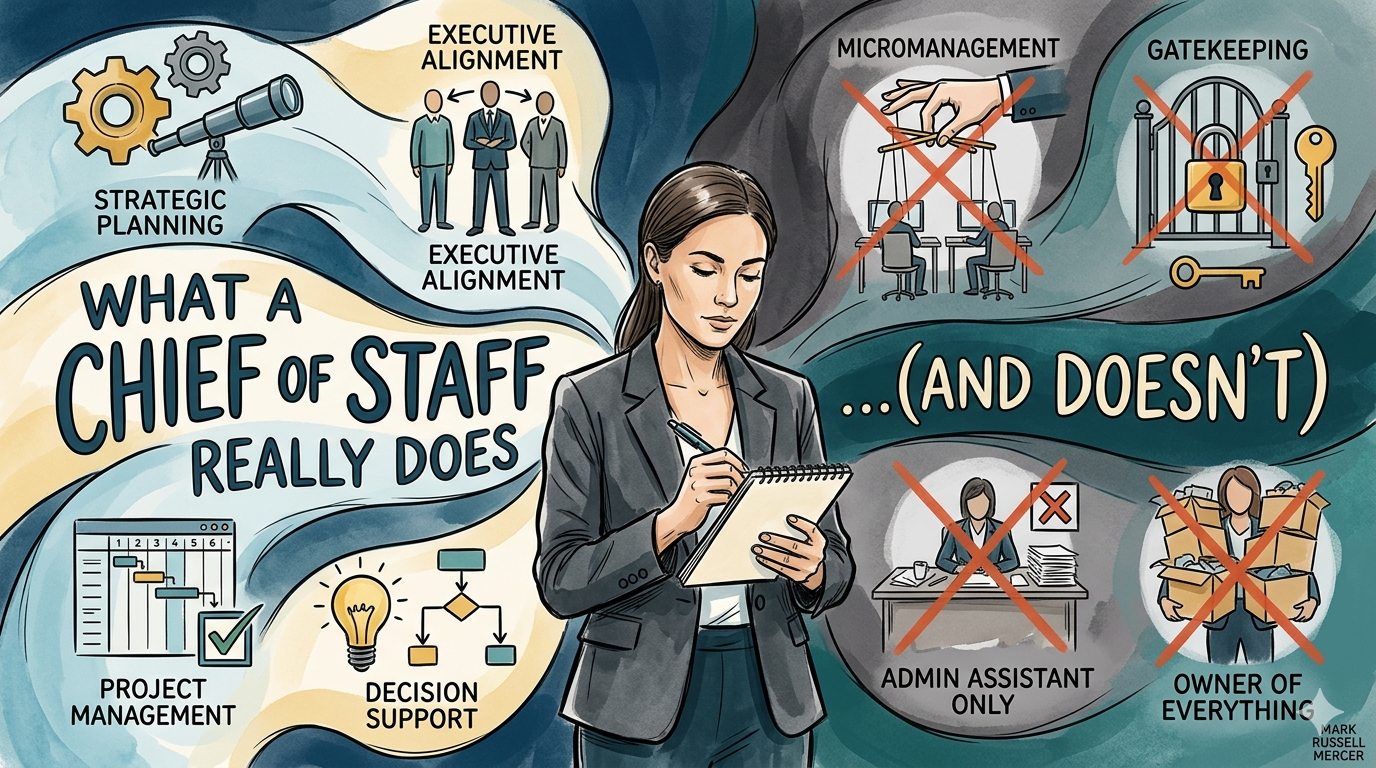
What a Chief of Staff Actually Does (And Doesn't)
There's a question I get more than any other: "So... what do you actually do?"
By Mark Mercer
There's a question I get more than any other: "So... what do you actually do?"
It usually comes with a slight tilt of the head. Sometimes a polite smile. Occasionally a follow-up like, "Is that like an executive assistant?" or "So you're basically the CEO's right hand?"
Not exactly. And definitely not exactly.
I'm the Chief of Staff at Firecrawl, a fast-growing AI startup in San Francisco. I've held the role for over a year now, and I still think most people — including people in tech — don't really understand what a Chief of Staff does. So let me try to clear it up.
What a Chief of Staff actually does
The simplest way I can put it: I make sure the company runs while the founders build the product.
That sounds broad because it is. On any given week, I might be negotiating a vendor contract, onboarding a new hire, managing our global tax registrations, planning a team offsite in Miami, reviewing our insurance coverage, writing an internal performance recap, or standing in a hardware store picking out shelving for the office I designed and built from scratch.
The role lives in the white space. It's every critical thing that doesn't fit neatly into an engineering sprint or a sales pipeline but absolutely has to get done for the company to function. Some of it is strategic. A lot of it is operational. All of it matters.
Here's a non-exhaustive list of what I own or have built at Firecrawl:
People & HR — I built our onboarding program, employee handbook, bonus structure, quarterly review framework, and performance evaluation system. I run People Ops. I'm the confidential layer between employees and founders.
Hiring — I centralized recruiting across multiple platforms, source candidates, manage every offer letter, and handle all hiring paperwork. I personally recruited our Head of Legal & Finance, negotiating a structure that cut outside counsel costs by $25,000 a month.
Legal & Compliance — I initiated 76 global tax registrations, trademarked our name and logo, overhauled our insurance across seven policy lines, cleaned up equity documentation, and manage all contracts and NDAs.
Finance — I manage billing through Brex, consolidated our finance tooling, led a company-wide vendor audit, and handle payroll workflows across PEO, EOR, and contractor models.
Office & Facilities — I designed and opened our SF headquarters end-to-end and run it day-to-day.
Events & Culture — I conceptualized and emceed a YC hackathon that drew 495 applicants, raised $60K in sponsorships, and distributed $5.2M in prizes. I created "Firecrawl After Dark," a monthly late-night developer event. I plan and execute team offsites.
Communications — I write monthly company performance recaps and coordinate cross-functional communication to keep 26 people aligned.
If you're keeping count, that's seven distinct functions. At a larger company, that's seven different people — or seven different departments.
What a Chief of Staff doesn't do
Let me be equally clear about what the role is not.
It's not an executive assistant role. I don't manage anyone's calendar or book travel for the CEO. I'm not handling personal errands. The EA and CoS roles share a surface-level similarity — they both exist to make leadership more effective — but the CoS operates at a strategic and operational level, not an administrative one.
It's not a project manager role. I don't track Jira tickets or run standups. I'm not embedded in a product team shipping features. When I manage projects, they're company-level operational initiatives, not product roadmap items.
It's not a "figure it out" dumping ground. At least, it shouldn't be. The best CoS relationships work because there's a clear understanding of what the CoS is uniquely positioned to handle versus what should go to a functional lead. I protect my time the same way I protect the founders' time — by being intentional about what I take on.
It's not a temporary role. Some companies treat the CoS as a rotational program or a stepping stone. For me, it's the role itself. Building operational infrastructure, scaling people systems, creating culture — this is the work I want to do, not a waypoint on the path to something else.
The skill set nobody tells you about
Most CoS job descriptions list things like "strategic thinking" and "cross-functional collaboration." Those are real, but they're also generic enough to describe half the roles in tech.
Here's what I think actually makes someone effective in this seat:
Comfort with ambiguity. Half of my job on any given day is something I haven't done before. You have to be genuinely comfortable figuring things out in real time — not theoretically comfortable, actually comfortable.
Taste. This one sounds strange, but I mean it. A good CoS has opinions about how things should feel — the onboarding experience, the office layout, the way a company update is worded, the vibe of a team offsite. Operations isn't just mechanics. It's experience design.
Speed without sloppiness. Startups move fast. The CoS has to move faster. But moving fast and breaking things is not the same as moving fast and building things that last. I build systems that I won't have to rebuild in three months.
Emotional intelligence. You're sitting between founders and the team. You hear things from both sides that neither side says to each other. Handling that with discretion, empathy, and honesty is probably the most undervalued part of the job.
Range. This is the big one. You need to be able to context-switch from a legal compliance question to a design decision to a difficult conversation with an employee to an event sponsorship negotiation — all in the same afternoon. Not everyone can do that. Not everyone wants to.
I can. And I do.
The punchline
A Chief of Staff is the person who builds the company around the product. The founders build the thing. I build the machine that lets the thing grow.
If your startup has reached a point where the founders are spending more time on operations than product, where things are falling through cracks, where nobody owns the stuff between the departments — you might need one of us.
And if you're someone who loves building from scratch, thrives in ambiguity, and has an unusual mix of skills that doesn't fit neatly into any single job description — you might already be one.
Mark Mercer is the Chief of Staff at Firecrawl. Before that, he built CX organizations, directed 2500+ performers, and ran retail teams. He lives in San Francisco with his partner Anthony and their Boston Terrier, Milo.