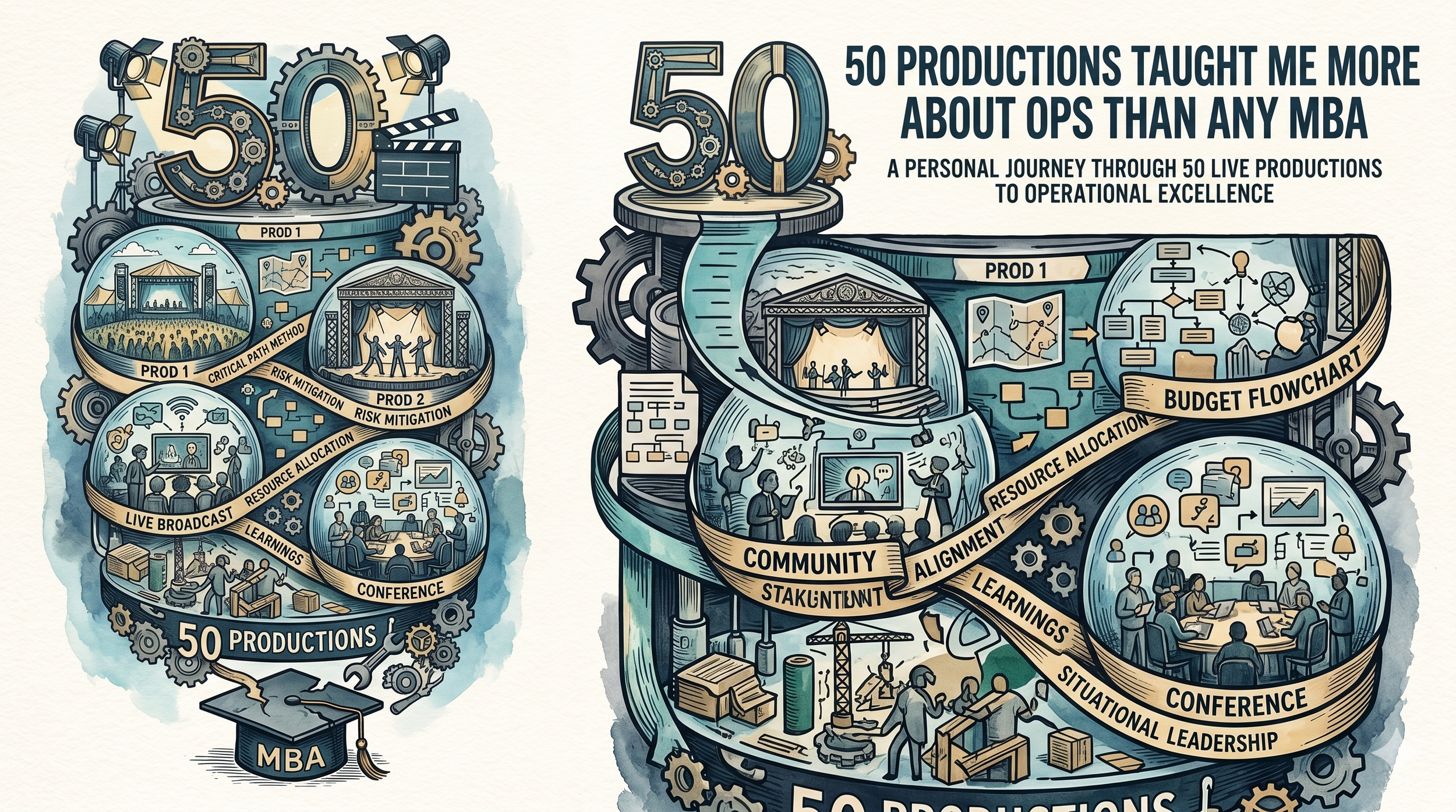
50 Productions Taught Me More About Ops Than Any MBA
I have an MBA in Finance.
By Mark Mercer
I have an MBA in Finance. I graduated with a 4.0 GPA and made the President's Honor Roll. I learned about capital structures, financial modeling, and strategic analysis.
And I'm going to be honest with you: I learned more about running a company from directing high school theater than I did from any classroom.
That's not a knock on business school. It's a statement about what operations actually requires — and where those instincts really come from.
Over 13 years in education, I directed 2500+ performers, managed 1000+ volunteers, produced 50+ award-winning productions, and ran budgets over $500K. I founded a theater company and a national competition that drew 35+ teams from 10+ states and 5,000+ spectators.
Every single one of those experiences taught me something I use today as Chief of Staff at an AI startup. Here's what I mean.
Lesson 1: You learn to build from literally nothing
When I started my first teaching job, there was no program. No budget. No costumes. No sets. No reputation. No parent volunteers. No community support. Just an empty room and a job title.
Sound familiar? That's a Series A startup.
I had to recruit students, convince parents, fundraise from scratch, build a curriculum, design the shows, hire choreographers, and produce results — all while justifying the program's existence to administrators who weren't sure it should exist.
By year three, we had 600+ students. By year five, we were competing nationally. By year eight, we were one of the top programs in the country.
The skill I built wasn't "teaching." It was building something from zero and scaling it — the same thing I now do every day at Firecrawl, where I joined as employee number 12 and built the company's entire operational infrastructure from nothing.
Lesson 2: Logistics at scale will humble you
Here's what it takes to put a competitive show choir on stage at a national competition:
54 performers who've rehearsed for six months. 18 instrumentalists. 12 stage crew. 35+ parent volunteers. Custom costumes at $800 each, designed in collaboration with a designer from Indianapolis using fabrics sourced from LA's garment district. Choreography from teams in Los Angeles and Chicago. Musical arrangements from Nashville, Burbank, and Michigan. A portable lighting rig that I personally programmed. Multiple buses. Hotels. Rooming lists. Meal plans accounting for allergies. Academic eligibility requirements for every single student.
And you do this six times a year. At competitions in different states. With teenagers.
If you can manage that — and I mean actually manage it, not just survive it — you can manage anything. Supply chain issues at a startup? Coordinating a global team offsite? Planning a hackathon for 250 people? Those are straightforward by comparison.
Operations is operations. The domain changes. The physics don't.
Lesson 3: Culture isn't a perk — it's the product
The best show choir programs in the country don't win because they have the best singers. They win because they have the best culture.
I learned this the hard way. In my early years, I focused obsessively on technical excellence — vocal quality, choreography precision, production value. And we were good. But we weren't great.
The shift happened when I started building culture with the same intentionality I brought to building shows. I created rituals. I set norms. I built a team identity that students fought to be part of. I held people to high standards — 3.0 GPA to participate, no exceptions — but I also built an environment where people felt seen, supported, and proud.
The results followed. Grand Champion awards. Best Vocals, Best Choreography, Best Costumes, Best Set, Best Theme. National recognition. A program that people still talk about.
I bring the same approach to every company I work at. Culture isn't the ping pong table or the happy hour. Culture is the set of unwritten rules that determine whether people give their best work or just show up. It's the most important operational system in any organization, and most operators completely ignore it.
Lesson 4: Directing is just leadership with a deadline
When you're directing a show, you have a fixed date. Opening night doesn't move. The audience is coming whether you're ready or not.
That means every rehearsal matters. Every decision has weight. You're constantly triaging — what needs attention now, what can wait, what needs to be delegated, what needs to be cut entirely. You're managing creative egos, technical constraints, budget realities, and emotional dynamics simultaneously.
You're also the person who holds the vision. Everyone in the room is looking to you for the answer to "what are we building and why does it matter?" If you can't articulate that clearly — and re-articulate it every single day — the whole thing falls apart.
This is exactly what leadership looks like at a startup. The deadlines are real. The resources are limited. The team is looking to you for clarity. And if you can't hold the vision while managing the chaos, nothing ships.
Lesson 5: You learn to read a room like your life depends on it
Directing a show means standing in front of 50+ people — teenagers, musicians, parent volunteers — and knowing within seconds whether the energy is right.
Are they focused? Are they checked out? Is someone having a bad day that's about to infect the whole rehearsal? Is the choreography not landing because the staging is wrong or because the energy is flat?
This is a skill you can't learn from a textbook. You develop it by doing it — hundreds of times, in high-pressure environments, with real consequences.
In a startup, I use this same instinct constantly. I can walk into a room and feel whether a team is aligned or fractured, whether someone is burning out, whether a meeting is productive or performative. That radar is worth more than any dashboard.
Lesson 6: The budget is always too small, and you build it anyway
I managed $500K+ budgets in education. That sounds like a lot until you realize it needs to cover costumes, sets, travel, arrangers, choreographers, lighting, sound, competition fees, and a hundred other things for multiple teams across an entire year.
You learn to be relentlessly resourceful. You fundraise. You negotiate. You find creative solutions. You learn which corners you can cut (fabric quality on understudies' backup costumes) and which you absolutely cannot (the sound system at the competition you're hosting for 5,000 people).
This maps directly to startup life, where the answer to "can we afford it?" is almost always "not really, but here's how we make it work."
The real lesson
The real lesson from 50 productions isn't any single one of these. It's that operations is a creative act.
Most people think of operations as the boring stuff — the processes, the spreadsheets, the compliance checklists. And those things matter. But great operations requires imagination. It requires the ability to see a vision, break it down into a hundred moving pieces, coordinate those pieces across different people and timelines, and deliver something that makes people feel something.
That's what directing a show taught me. That's what I bring to every company I work with.
The stage is different now. But the work is the same: high stakes, high craft, lots of moving pieces.
Mark Mercer is the Chief of Staff at Firecrawl. He spent 13 years in education before transitioning to tech, and he still thinks the best leadership training in the world is directing a room full of teenagers toward something they didn't think they could do.